
AI support · · 9 min read · Reviewed by the DobroDesk editorial team · Updated
AI customer support works better with human review
Where summaries, cited drafts and automation help a support team—and which customer decisions should remain explicit human actions.
A customer asks why an invoice changed and whether the team can reverse it. AI can summarize the account history, find the current billing policy and draft a clear explanation. It cannot decide that an exception should be granted unless the product has given it that authority—and most support teams should not begin there.
The useful question is not how many conversations can be automated. Ask which parts of a correct reply are repetitive, supported by evidence and easy for a person to review. Reading a long thread and locating a policy are good candidates. Exercising discretion over money, identity or safety is a different kind of work.
Start with summaries and approved knowledge
Summaries are a practical first step. A handoff summary should capture the customer's current request, actions already taken, unresolved questions and promises the team made. The original timeline remains available because a summary is an entry point, not a replacement for the record.
Knowledge lookup comes next. The system should search only approved sources available to the current Inbox and show the passage behind each important claim. An agent needs to see whether the policy is current, applies to this product and actually supports the proposed answer.
Allow the draft to stop when evidence is missing
A draft should be allowed to stop. When the evidence is incomplete, asking one focused follow-up or recommending a handoff is better than inventing a refund, delivery date or account action. Fluency makes unsupported details harder to notice, not safer.
Review rules should follow risk. A well-supported answer about where to find an export may need a quick check. Billing exceptions, account ownership, deletion, privacy, abuse, legal and security cases should remain explicit human decisions even when the model sounds certain.
Separate reviewing an answer from authorizing an action
Show the reviewer what they are approving: sources, unresolved uncertainty, sensitive intent and any proposed customer-visible action. A single confidence badge compresses too much. The person needs enough information to understand why the draft exists and what could still be wrong.
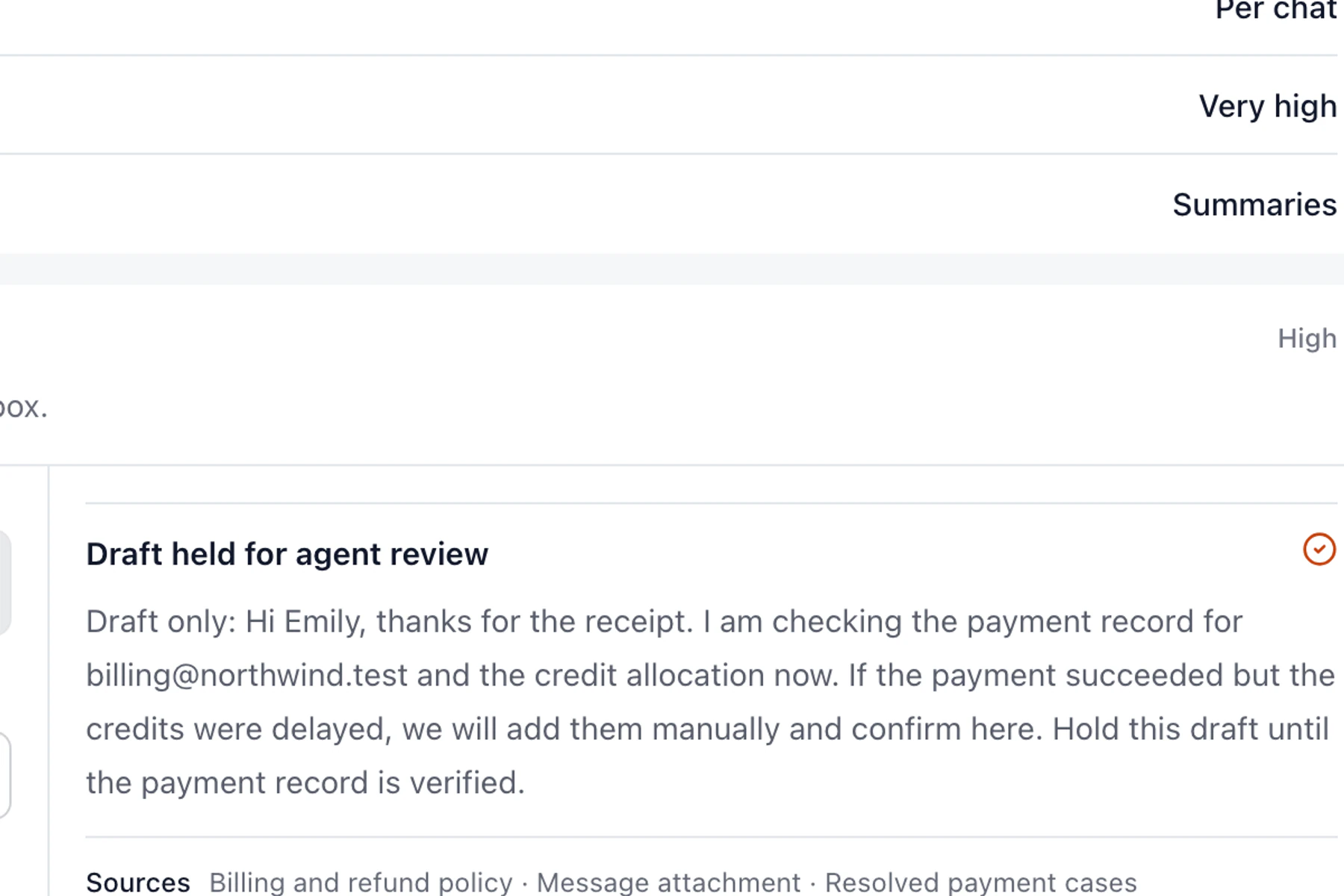
Suggestions and actions belong on opposite sides of a clear boundary. AI may recommend a reply, route or escalation. Sending the message, issuing money, changing access or closing a sensitive case should require an authorized action and leave an audit record.
Build a test set before expanding automation
Build the evaluation set from uncomfortable cases. Include an outdated policy, an ambiguous identity request, a prompt injection inside customer text, a missing-source question and a request that must escalate. Score factual support, source fit, safe refusal and correct handoff before scoring tone.
Roll out one control at a time: agent-only search, then summaries, then approval-only drafts, then a narrow low-risk automation. Each expansion needs a measurable quality threshold and a simple way back. Broad automation is difficult to debug when retrieval, drafting and action all change together.
Agent corrections are useful evidence. If people repeatedly delete the same claim, the root cause may be a stale source, weak routing or an instruction that asks the model to guess. Treat the edit pattern as a product signal rather than hiding it inside an aggregate acceptance rate.
Human review is not unfinished automation. It is the control that lets a support team use fast reading and drafting without surrendering authority. The goal is the least human effort that still produces a supported, accountable outcome—not the largest number of messages sent without a person.